Cenote Dos Ojos: Jumping at shadows and not letting intrusive (dive) thoughts win

I’ve dove Dos Ojos a few times. I know that it’s a popular cenote with both snorkelers and scuba divers getting their first taste of cenote diving. For me, I happen to like Dos Ojos. Despite having a few dives in this particular cenote, I always find it an enjoyable dive.

This time around, it was the desire to do three cenote dives in one day that brought me back. Typically, when someone wants to do three cenote dives in a day, a dive shop will take you to the Dos Ojos park, where there are at least 4 other cenotes besides Dos Ojos all close by. Sometimes you’ll dive the Pit, sometimes el Jaguar. Today, the schedule was Nicte-Ha (at my request) followed by two dives at Dos Ojos.
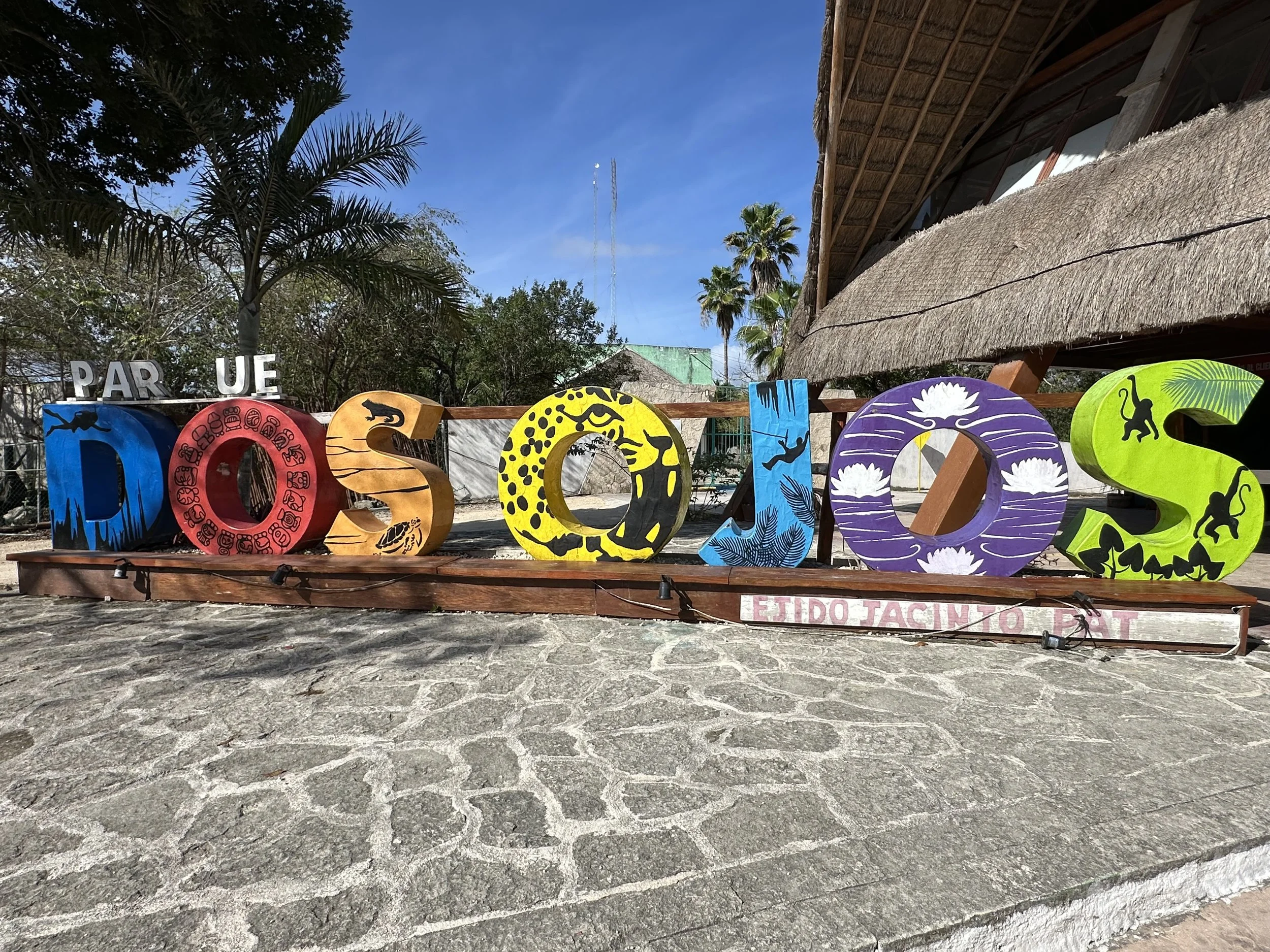
By the time we arrived at the entrance to Dos Ojos for the second and third dives, numerous other divers were already there. During our second dive, we pass so many divers underwater that it feels a little like a busy thoroughfare. Their lights bring an artificial brightness and illuminate a vast swath of the cavern.

So the stark contrast on dive three, when we virtually had the whole cenote to ourselves, led to an eerie feeling. Suddenly, the over illumination is gone, leaving just my and my guide’s lights. Tiny fish swim across the light beam, casting large shadows and making me look for much larger fish. The rational part of my brain, the part that knows this dive, knows there are no large fish in here. But the irrational part, the part that likes to intensify my fears when the lights go out, says, “what if there is a larger fish in those snaking tunnels that cavern divers just aren’t supposed to go?” Realistically, I know that cavern divers aren’t supposed to go down those tunnels due to safety reasons. That enters true cave diving territory, and that requires a lot more training.

But the tiny fish continue to swim through the light beams, and on more than one occasion, an oversized shadow has me looking for the fish that cast it.

Deeper into the cenote, we find another entrance, one that a few other snorkelers have access to. While we are aware they are there, I’m not so sure they know we are. It’s very shallow at this spot, maybe 5 feet deep, and an insidious thought creeps into my mind. I could reach out and pinch this snorkeler, who may or may not know I’m here and who is getting a little close to kicking me from above. The thought entertains me for a moment: becoming a cave monster, that thing that lurks in the dark and grabs an unsuspecting tourist. But I keep my hands to myself, knowing full well that while I might find it funny, I’m equally sure they won’t.

By the time we surface, the area is almost clear of divers. Maybe one or two stragglers, but certainly not the large numbers we saw an hour ago. We slowly break down our gear and start to pack up before another diver points out that we have a very flat tire. In an impressive display of MacGyver-ism, my guide uses one of my tanks and my regulator hose to put enough air back in the tire to get us, at least, to a nearby auto shop. The drive on dirt roads out of the jungle is a cause of amusement, driving slowly so we don’t re-deflate the tire. I am unbothered by this development as it seems par for the course when having jungle adventures.

Searching for Hammerheads at Gordo Banks

The day is much nicer than the last time I made this trip. Four years ago, it was overcast, windy and giant swells continuously sent me flying into the air before landing on the hard bench again. We were the only boat in the area when we finally arrived at the undersea mount. The dives were . . . disappointing, only because we saw nothing but endless blue — no hammerheads were found.

This time, the skies are a clear blue and though my skin is constantly wet from the sea spray, the sun quickly warms me up. There’s still good size swells and I’m still sent flying into the air, but this time not nearly as high or as often. There are several other boats — both diving and fishing — in the area and we have to wait some time for the other divers to descend before we get into the water. The second the first diver hits the water, it’s clear that we’re going to have a strong current on the surface to fight against.

I’m hoping beyond hope that this time I’ll see Hammerheads. Talks with other operators from the previous day give me hope — according to them, most trips out to Gordo banks has resulted in Hammerhead sightings. They can’t really guarantee it, but suggest there’s a high probability that we will.

As we descended into the blue I am . . . once again disappointed. While the water is crystal blue and underwater visibility is incredible we see nothing. No sharks, no turtles, we barely make it to the top of the sea mount. We don’t even see any fish. We’re sure the sharks are around, but currently hiding from us divers. I’m disappointed, naturally. But it’s not like the sharks will show up on demand.

As it stands, Gordo Banks: 2; Me: 0

Maybe next time.

A Day With A Blue

A rare time of day when there are no other boats in front of the famous Los Arcos of Cabo San Lucas

It’s a nearly perfect day as we leave the Cabo San Lucas marina and head for open ocean. The six of us that make up this “tour” are hoping to see big pelagic sharks. I can’t contain my excitement, I don’t know what to expect and I’m hoping to see Blue sharks. They’re beautiful and a little hard to come by. Of course, I’ll be happy seeing any shark. While, I’ve spent time in the water with lots of reef sharks, this will be a totally new and different experience. No cage — which doesn’t concern me — but these sharks are curios. We are repeatedly told that we might be the first humans these sharks have ever encountered.

Six to seven miles off shore, the boat stops and the crew starts to throw chum in the water. Finding open ocean wanders is like trying to find a needle in haystack — there’s a lot of open ocean and those sharks could be anywhere. But the wind is good and the currant strong, the chum will travel a good distance and hopefully, attract some sharks.

After sometime, we get our first visitor. A small and somewhat shy Smooth Hammerhead shark. The shark is skittish and bolts before we have the chance to get in the water. So the chumming continues. He returns, but again, only one of us manages to jump in before he fleas. It’s a shame because I’ve been hoping to see Hammerheads for a long time. We all get in the water anyways, hoping that maybe he’ll return for a third time. But after a solid 15 mins of hanging on the surface line, being dragged like rag dolls in the surge and currant, we know the Hammerhead is not coming back.

After another long interval sitting on the boat and swapping stories, a beautiful Blue shark appears. He’s maybe six or seven feet long and very chill — no signs of aggression. We were told before leaving the marina that Blue’s are inquisitive and will come in real close. It’s apparent as the fist of us get in the water that is the case. He makes incredibly close passes and at times it’s necessary to use my fins as a buffer so he doesn’t get too close.

While in the water, it’s necessary to track him because Blue’s can be opportunistic. There are birds here hoping scavenge any scraps they can from the sharks. I’m paying such close attention to the Blue shark that I don’t notice a bird that’s floating right next to my head hoping for fish bits. Suddenly, the shark turns on a dime and comes towards me with his jaws open — he’s taking a snap at the bird I haven’t noticed. I scramble out of the way as he makes a very close pass near my head — but the interaction is exhilarating and only makes me appreciate the Blue shark more.

All too soon it’s time for us to leave him. We fling the remaining scrapes over the side of the boat and start to move back towards shore. The entire experience has me craving more time in the water with these magnificent animals.

The Magic of Surface Intervals

Sometimes, just sometimes, surface intervals are more wonderful than the diving itself. It only happens once in a blue moon and please don’t misunderstand me, surface intervals often provide amazing experiences, but rarely are they better than the diving. Recent diving off of Cabo San Lucas in the Sea of Cortez showcased just how amazing they can be.

Not the world’s greatest picture, but you can see some of the numerous rays underwater.

Not the world’s greatest picture, but you can see some of the numerous rays underwater.

Day one of three days diving. The sun is hiding behind some clouds, but it’s warm. The boat is moving swiftly along to our first dive site and lulled by the gentle rocking of the boat on the smooth surface of the water, I doze on the bow. The boat idles and the sudden smack of a large body hitting the water jolts me upright. We’ve stumbled across Mobula Rays, launching themselves from the depths to the surface. Only a few leap at a time, but I’m enthralled. So enthralled in fact that my fellow divers tell me to look down just below the water’s surface. I immediately understand why. Just below the boat there are hundreds of rays gathering.Of course, I’ve seen this happen before on nature documentaries but to see it in person, well, sight is unbelievable to witness and it’s impossible to not be fascinated by these massive animals jumping feet into the air, as though they are attempting to fly.

Day two and it’s grey and cloudy. The weather is still warm but the sea is rocky. It’s two hours by boat to an underwater sea mount in the hopes of finding hammerheads. Sadly, no such luck. The waves have gotten worse during our few hours out in the open ocean, causing the boat to rock tumultuously and creating a similar effect to a roller coaster. It’s tricky getting back into the tiny boat from the water. A

As we start our two hour boat ride back from the remote sea mount, we are joined by whales. At first just one or two. Then after a few minutes, more appear. Suddenly, we’re accompanied by more than 5 whales. And they’re curious. They are very close to our small boat, and every few minutes one will spyhop —- stick is head/upper body out of the water to check us out.

Pretty soon, they’re breaching with a bit of frequency and we’re treated to our own private show. Time and again we watch in awe as the whales throw their whole bodies out of the water —- each breech for spectacular than the last. This goes on for sometime until finally, they head off into the blue.

All thoughts of the less than stellar dives have been pushed from our thoughts, replaced by the humpbacks that just left us.